Friday, 8 March 2019

My DNA results are back!

I'm very excited to report that my DNA results came back from 23andMe last week. It was a busy week so I didn't get to examine them in much detail at the time. Now I'm digging into them and have high hopes for what they might yield in terms of family connections.
The 23andMe DNA test focuses quite extensively on health issues but I won't go into any of that. Of far more interest to readers of this blog is what the test reveals about my ancestry. In this post i will focus on what I've learnt about my connection to population groups around the world, and in future posts i will delve into my DNA relatives. At this point I scarcely know what the process of identifying DNA relatives entails so no promises about imminent genetic breakthroughs!
To recap the story thus far, my daughters bought me a DNA test kit for my birthday in January. While on holiday in England I supplied the requisite amount of saliva and sent off my sample. The sample made its way to the laboratory and was processed. Finally, I received an email containing a link to my results and all the detailed reports.
I learnt that my ancestry is 100% European, composed of the following:
59,4% British and Irish 18,1% French and German 3,2% Scandinavian
With reference to British and Irish ancestry, the evidence suggests that, in the last 200 years, my ancestors probably lived in greater London, greater Manchester, Lancashire, Merseyside, County Durham, Warwickshire, Derbyshire, Cornwall, North Yorkshire and Stoke-on-Trent. Guernsey and Ireland did not feature at all in terms of recent ancestry.
The French and German part of my ancestry relates to people descended from ancient Celtic and Germanic populations which spread from the Netherlands to Austria. My DNA test results suggest that, in the last 200 years, my ancestors were most likely to have lived in the Netherlands with Germany coming in as a "possible match". The researchers were unable to detect enough evidence of recent ancestry from Austria, Belgium, France, Luxembourg or Switzerland.
The portion of my ancestry connected to the Scandinavian countries of Norway, Sweden, Denmark and Iceland is relatively small. My DNA report from 23andMe was unable to provide a detailed breakdown of where my relatives may have lived in the last 200 years. I guess this is because findings are based on matches in the data base and there are presently no matches, or perhaps too few matches to say anything for certain.
As for the rest of my ancestry composition, I have apparently inherited 0,6% of my DNA from Spanish and Portuguese populations, 18,5% from "Broadly North-Western European" populations, and 0,2% from "Broadly Southern European" populations. These last 2 categories exist because DNA is common to several specific populations dotted across a large area, reflecting the migration of people groups way back in history. There is also the possibility, not stated in the report, that this blended DNA could be linkked to royal lineages since the royal families of Europe are known to have intermarried for centuries. I shall make enquiries and bring you the answer when I have it!
Photo credit: "Map of England, Undated" by Nathan Hughes Hamilton.

Wednesday, 6 March 2019

David Scott Ritchie Sr dies at Hanwell

The final record contained in the research report I received from Judy Lester was a death record for my great-grandfather David Scott Ritchie Sr. An image of the death certificate was included. After learning that I am visually impaired, Judy kindly transcribed it for me so I could access all the available details.
David Ritchie Sr died on 31 January 1967 at the age of 92. The cause of death is stated as bronchopneumonia, which isn't surprising because it was the middle of winter. The death certificate also states that he was suffering from senility. His death was first reported by a fellow inmate of the hospital and certified by somebody called GC Siegruhn MB. The name of the hospital registrar is also given on the certificate.
Surviving in a mental institution to the age of 92 must be something of an anomaly, I should think. David Ritchie Sr was admitted to the asylum at 35, which meant he spent an incredible 57 years of his life disconnected from the world. Two world wars passed him by. His son raised a family in South Africa and his granddaughters both married and had children. His wife of 65 years, Maude Alice Ritchie, probably predeceased him by several years.
Most astonishing to me is that this great-grandfather of mine was alive when I was born in 1963. I never even knew of his existence. Granted, I probably never thought to ask about him when I was growing up but that was because my parents never referred to any great-grandparents at all, either on my father's side or my mother's side. We just weren't a very connected family, or so I thought. it didn't occur to me that there was a skeleton in the cupboard. Obviously, someone at some point made a conscious decision to distance him- or herself from the lunatic in the asylum and so a deep silence fell around the man. I myself wouldn't have discovered the secret except that my sister and I needed to find a birth certificate for my grandfather in order to apply for UK citizenship.
It may be possible to learn more about my great-grandfather's life at St Bernard's Hospital. Although the formal medical case-book is closed to public access under the 100-year privacy rule because it includes entries made after 1918 I could perhaps find details relating to his admission in 1909. Certainly, his is an intriguing story which i feel compelled to investigate further.
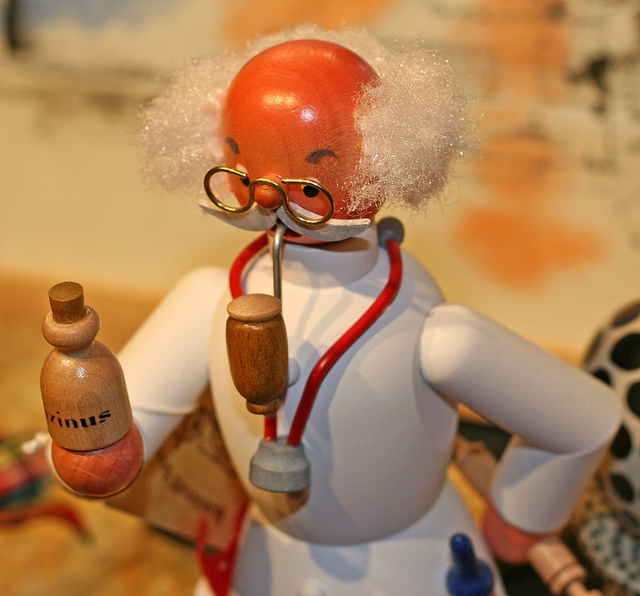
Photo credit: "Old time doc" by Thad Zajdowicz.

Monday, 4 March 2019

Growing old at St Bernard's Hospital, Hanwell

The 1939 Identity Register for England and Wales was far-reaching. Among those people it enumerated were patients of mental hospitals. Thus we find my great-grandfather, David Scott Ritchie Sr listed as an inmate of St Bernard's Hospital, formerly the London County Asylum, in the month that England declared war on Germany.
The entry is straightforward. David S. Ritchie, born 1874, is married and worked as a butler before admission to the institution. The stated birth date, marital status and occupation tell us this is the right person. From here, we can fill out the picture with what we already know, and this is where it becomes both interesting and extremely sad.
David Ritchie Sr was admitted to the lunatic asylum in 1909. At the time of the 1939 Register, therefore, he has already been an inmate for 30 years. He has a wife named Maude who is 60 years old and temporarily out of work. it is possible that he has not seen her for years because of his mental illness. He has a son who is 37 years old and an electrical engineer heading up an overseas office of a big international company. This son may or may not know where he is or whether he is still alive. He has a daughter-in-law and two young granddaughters who, at the time of the 1939 Register, are holidaying in Dorset and visiting relatives in London. He has a brother, Thomas Scott Ritchie, who is still alive and living nearby, plus grown-up nephews and nieces, the children of his deceased older brother William, living in Canada. All these family connections could have provided meaningful relationships and yet he is alone and being looked after in a paupers' institution for the insane.
I can't help comparing attitudes towards the mentally ill in those days with attitudes today. Times have changed, to be sure, and much has to do with advances in treatment. if David Scott Ritchie Sr suffered from what we now call bipolar disorder, for example, his doctor would have diagnosed lunacy and ordered him to be locked up as a matter of course. Today the same symptoms can be managed with medication and those suffering from it can generally go on with their normal lives, pursuing professional careers and making valuable contributions to the world. Moreover, there isn't the same stigma attached to mental illness as there used to be. Whereas families were inclined to hide away their so-called "mad" relatives, nowadays we extend compassion, encouraging treatment and offering support to those who are afflicted.
Because of the way things were back in the first half of the 20th century, a diagnosis of insanity meant that my great-grandfather was cut off from the outside world. The First World War would have completely passed him by. The Second World War would affect him more personally as the hospital at Hanwell would take a couple of direct hits from German bombers in the Blitz, but even so, the deprivations, losses, hardships and movements to and fro as a result of fighting would probably touch him very little. Spending his days working in the garden, baking bread, doing handcrafts or playing cards, he would go through the war only dimly aware of the changes taking place beyond the hospital walls.
Photo credit: "The Bedroom [1889] by Vincent van Gogh," photographed by Rawpixel Ltd.

Saturday, 2 March 2019

Finding Maude Alice Ritchie on the 1939 Register

Documents never cease to amaze me. The 1939 Identity Register taken at the end of September, just weeks after Britain declared war on Germany, is a veritable goldmine of family information, which is why I was so glad when Judy Lester did what I could not and traced Maude Alice Ritchie in that record.
To put this in context, Maude had been separated from her husband David Scott Ritchie Sr since 1909. Her son David, my grandfather, had been cared for by his aunt and uncle, the Smiths, so that she could work. She had been occupied as a cook in domestic service since at least 1911, the year of the census, and possibly many years before that. The First World War had taken place during her late thirties, and she had said goodbye to her son and his wife when they moved to Cape Town, around her 50th birthday. The outbreak of the Second World War and the 1939 Register happened when she was 60.
Thanks to the Register, I now know that Maude was living in a multi-occupancy house at 167 Fernhead Road, Paddington in the first month of the war. From descriptions of Fernhead Road on the internet [bearing in mind I can't read a map[, I gather it runs from Harrow Road in what was then North Paddington through Shirland Road and Fordingley Road. Tall 19th-century houses characterise the area's architecture, nowadays mostly converted into flats. The area is now called Maida Hill and there is a daily market held in the piazza at the intersection between Harrow and Fernhead Roads. Incidentally, the house at number 91 Fernhead Road was the childhood home of the British comedian Norman Wisdom, although he would have been 24 when the register was taken and probably living elsewhere by then.
Maude's neighbours were middle-aged and elderly folk like herself. William and Emily Burge were in their late fifties, he a master builder and she doing "unpaid domestic duties" at home. Edward and Beatrice Winyard were in their late forties, he a porter at a medical institution and she a housewife involved in the preparation of food. The Taylors were a widow and her son, Sarah aged 77 and Stuart aged 39. Stuart was unmarried and a shopkeeper at a grocery store. Maude had no-one living with her and was temporarily without a job. Her entry on the register relating to occupation says "Cook when employed".
This, then, is where my grandfather and his family would have visited her when they travelled from Cape Town to England in the summer of 1939. It is hard to picture my mother at age 4 ascending the stairs of this house full of strangers. I know nothing about Maude's personality, whether she would have hugged the children warmly or maintained a rigid pose befitting of a servant in a well-to-do household. Was she jolly or strict, fond of little ones or disapproving of their playfulness? All I know is that Mom never spoke of her. If Maude encouraged visits to her flat, she certainly didn't make a big impression on her granddaughters.
Photo credit: "Squirrel, Maida Hill, W9: by Ewan Munro.